

The Two Goulds
Goldberg Variations · Glenn Gould · Columbia/CBS · 1955 + 1981


Edition №7
I first heard Glenn Gould while I was working at a record store. It was Sound Warehouse in Dallas, near SMU, the one location that stocked nothing but classical and jazz. I couldn’t tell you which recording was playing. What stopped me was the humming. Under the Bach, a man’s voice is singing along, off-mic and not quite on purpose. Once you catch it you can’t let it go. Two coworkers with a deeper knowledge of classical music told me it was Glenn Gould. He hummed while he played, loud enough to end up on the records.
The more I learned about him, the more he pulled me in. He gave his last public concert in 1964, at 31, and never played for a live audience again. He called the concert a “blood sport” and something close to a force of evil, and he meant it. He walked into the recording studio instead and more or less never left, editing his own takes the way a film director edits a movie, which is close to how he described his process. I still don’t have a good grip on Glenn Gould the man. He was strange, private and complicated in ways I won’t pretend to diagnose. What I have is a deep respect for how unconventional he was willing to be, and a talent that has outlived him by decades with no sign of fading.
He recorded Bach’s Goldberg Variations twice, 26 years apart. Most people who love this music own one of them. Almost nobody tells you the rest: the two recordings were made in different technological worlds, and that gap decides which one you should buy, and on what. One of the two hides a surprise about which copy actually sounds best.
The verdict is free. Subscribe and read the rest.
The chain
Glenn Gould recorded Bach’s Goldberg Variations twice, 26 years apart, and the best-sounding version of one of them is a compact disc that no pressing can beat, because the 1981 was digital from the start. The two recordings come from different technological worlds. The 1955 is analog to its bones. The 1981 was among the early digital recordings by a major pianist. That gap decides what you buy.
1955. Recorded June 1955 · Columbia 30th Street Studio, New York · produced by Howard Scott, engineered by Fred Plaut · mono · released 1956. The version worth owning today is the 2015 Andreas Meyer remaster, transferred to digital from the first-generation Columbia tapes.
1981. Recorded April to May 1981 · the same studio, in its final sessions before it closed for good · recorded digitally · released 1982, weeks before Gould died. The version worth owning is the original 1982 digital master he approved.
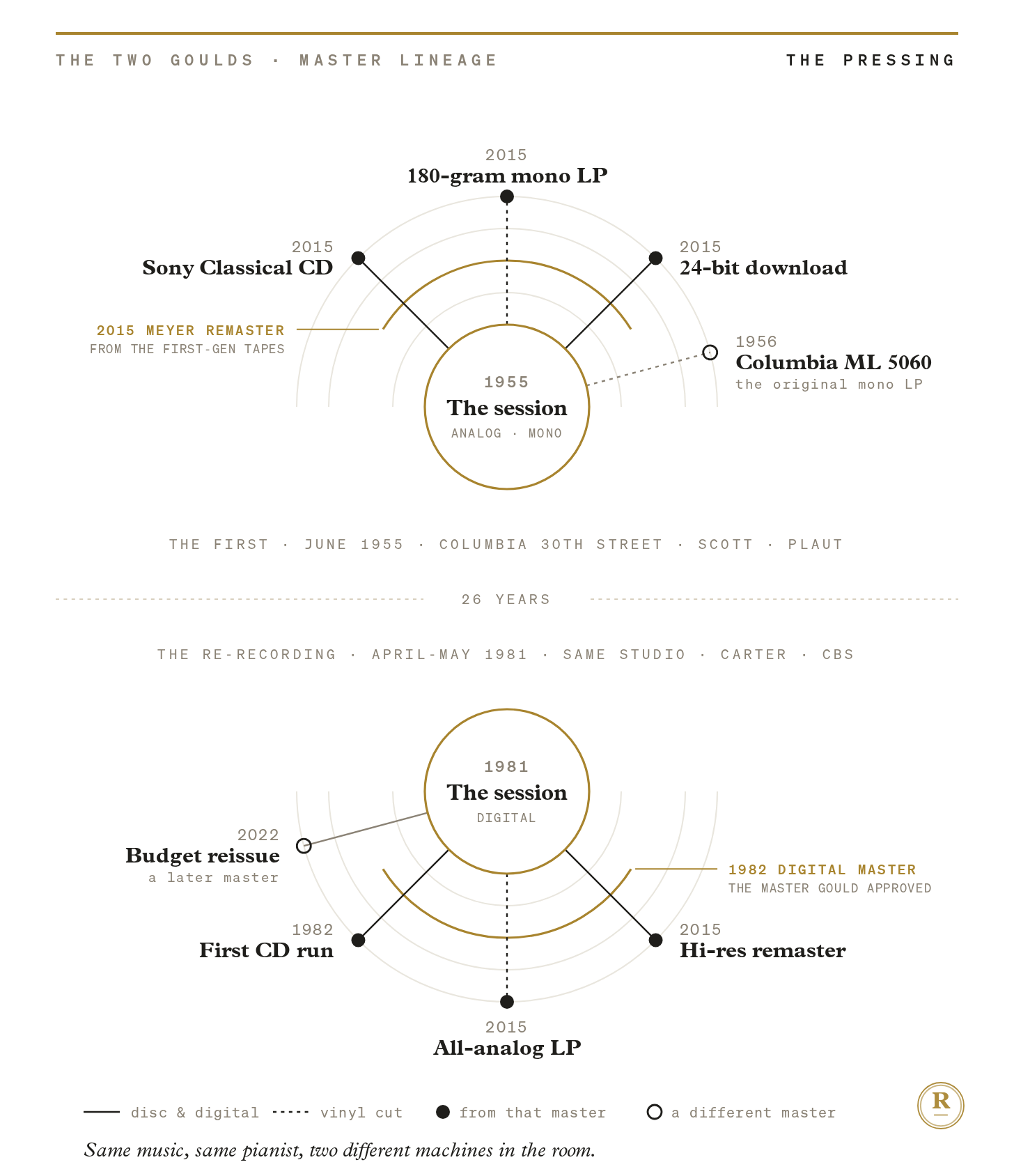
The commercial gap is as wide as the sonic one. The 1955 sold more than 100,000 copies in Gould’s lifetime, a staggering number for a solo Bach record. The 1981 has sold more than 2 million. Same music, same pianist, two different machines in the room.
The tape does lie, and nearly always gets away with it.
— Glenn Gould, “The Prospects of Recording” (1966)
The musicianship
The clearest difference is on the clock. Gould played the 1955 in 38 minutes and 34 seconds. He played the 1981 in 51 minutes and 18 seconds. That is 13 minutes slower, a third longer, the same score. The young man raced; the older man weighed every bar.
Performer. Glenn Gould, piano, on both.
1955 production. Howard Scott, producer · Fred Plaut, engineer.
1981 production. Samuel H. Carter, producer, with the CBS Masterworks studio team.
He re-recorded because he had come to reject the first one. He thought the 1955 was too fast and too showy, and he wanted the 1981 to hold together as a single arc rather than 30 brilliant sprints. The result is slower, graver and more deliberate, the reading of a man who had spent his career deciding that interpretation belonged in the studio, where he could control every note.
The verdict
Here the two records split for good. On the 1955, the reference lives on vinyl if you want it there. On the 1981, it does not, because a digital recording has no analog original for a lathe to cut from.
The rubric, in plain terms.
For the 1955, the reference is the 2015 Andreas Meyer remaster, taken from the first-generation tapes. It comes three ways as equals: the Sony Classical remastered CD, the 180-gram mono LP and the 24-bit hi-res download. Buy the format you love or prefer; the master is the same.
For the 1981, the reference is the original 1982 digital master Gould approved, on its first CD run. The same master carries the best hi-res download. The best vinyl, a 2015 all-analog cut, is warmer and worth hearing, but it sits a step off a digital source and it does not win.
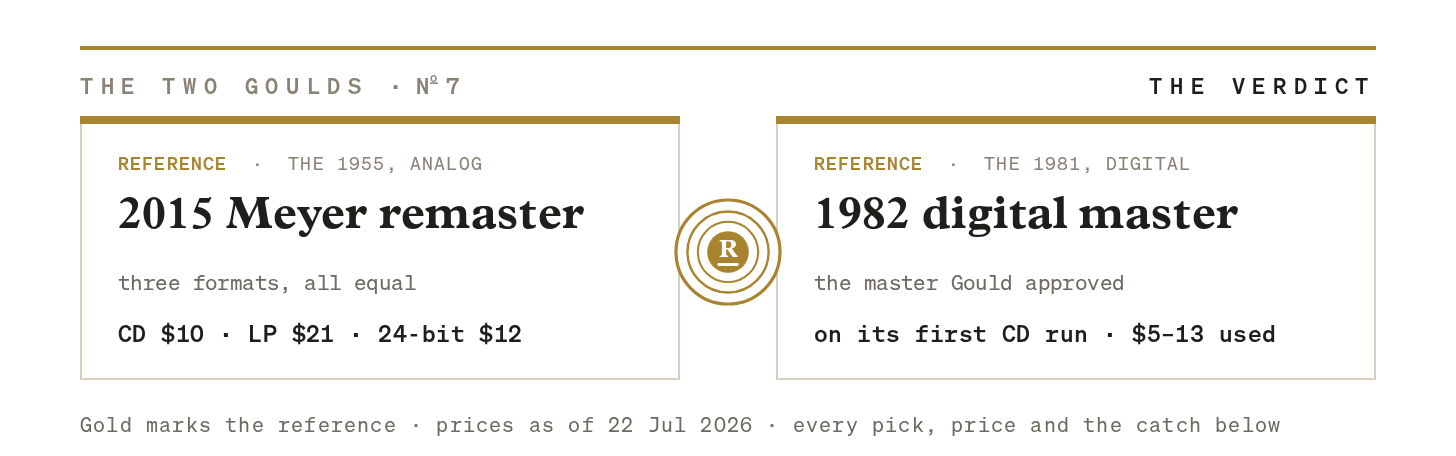
Best 1955, any format. The 2015 Meyer remaster, from the first-generation tapes. About $10 used on CD, about $21 new on 180-gram mono vinyl, or about $12 as a 24-bit download.
Best 1981. The 1982 digital master Gould approved, on CD. Inexpensive on the used market, roughly $5 to $13.
Best 1981 download. The 2015 hi-res remaster of the digital master. About $12 on Qobuz.
The 1981 on vinyl. The 2015 all-analog cut. Around $26 when you can find it, and it is now hard to find new. A near-peer, warmer, not the reference.
One catch worth knowing. The cheapest new 1981 CD on shelves today, a 2022 budget reissue at about $16, carries a different and later master than the reference, not the 1982 master Gould approved. Buy it if you want the performance at the lowest price, but buy it knowing which master you are getting.
The endnote
I still hear the humming first. It is the most human thing on either record, a man so far inside the music that he forgot to be quiet, and it is right there on the tape. Gould spent his life arguing that the real performance happened in the studio, where he could shape every note. He died weeks after the second Goldberg came out, still making that argument. I never got a firm grip on him as a man, and I am not sure anyone did. What lasts is the playing and the strange, exact conviction behind it.
Next Up: Norah Jones, Come Away with Me, the quiet debut that turned into an audiophile touchstone.
Reference Checks, a Twelve Bar Studio production, is an evidence-led publication on the recording versions worth a serious listener’s time. The reviewer’s listening chain is calibration context, named in the About page and absent from every verdict. Full evidence chain for this post is in the Reference Checks research dossier. Research uses AI tooling; verification and editorial are human. See Editorial process.