



Edition №9
The Dark Side of the Moon spent 736 weeks on the Billboard 200 between March 1973 and July 1988. Until this spring I had never owned a copy.
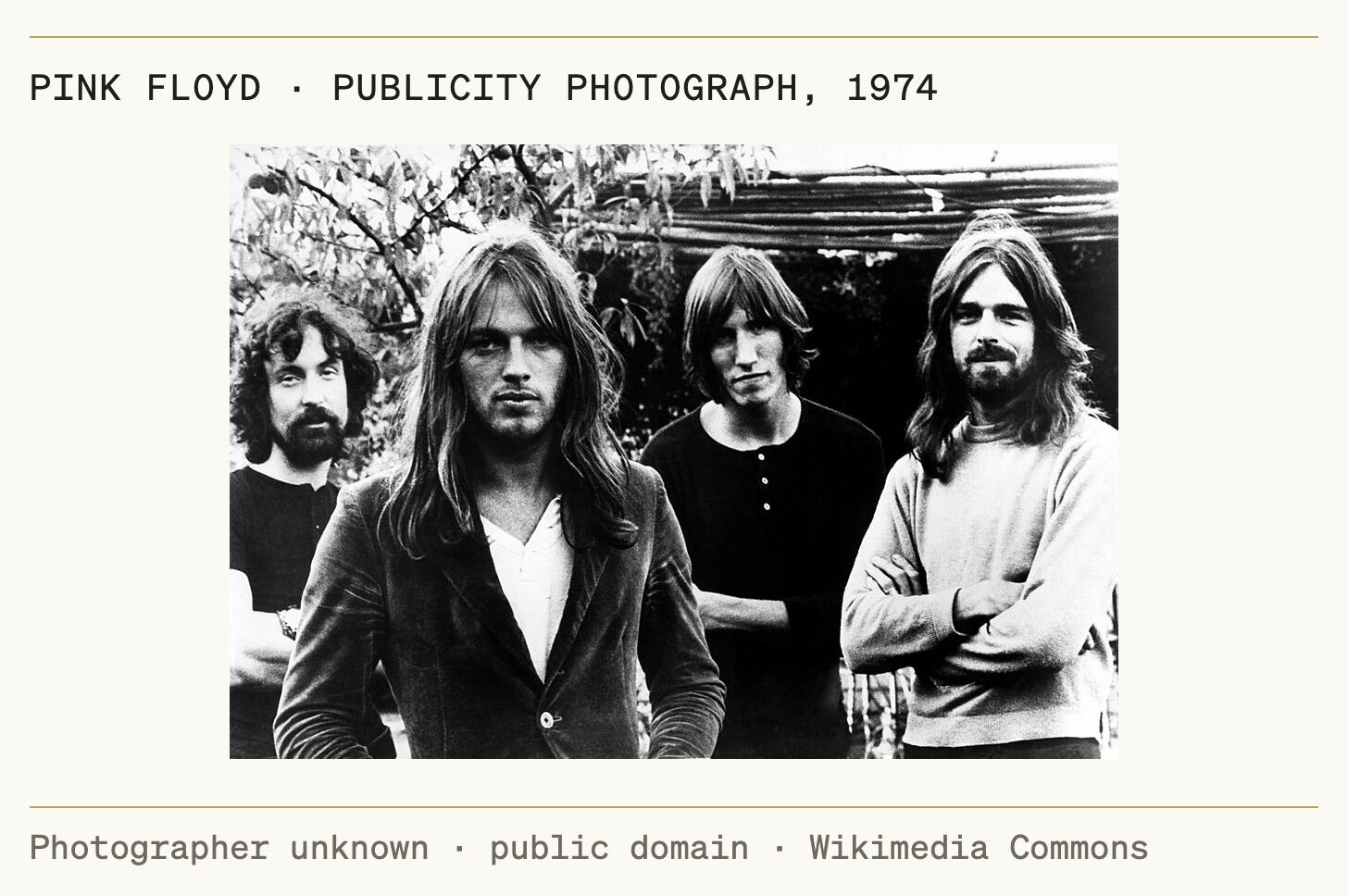
I was a big fan of The Wall as a kid. My childhood best friend and I would call our local radio station begging them to play "Another Brick in the Wall," the long version that runs "The Happiest Days of Our Lives" into Part 2, and wait for hours with our tape recorders to grab a clean recording. I never dug into the back catalog until the Wizard of Oz play-along business. A college intern named Charlie Savage wrote it up in The Journal Gazette in Fort Wayne, having picked it up from a Pink Floyd newsgroup: start the album as the MGM lion roars and the album and the film run together. Savage's piece said the first roar. The third roar is what everyone settled on later. I was in college, and everyone had a version of it.
Gilmour, Waters and Mason have all denied it. Alan Parsons, who engineered the record, gave the denial that explains it clearly, because his is about equipment. “There simply wasn’t mechanics to do it,” he told MTV in 1997. “We had no means of playing videotapes in the room at all. I don’t think VHS had come along by ‘72, had it?”
That is the sentence that got me listening properly. Parsons was engineering at Abbey Road on a Studer A80 16-track, and the limit he is describing is the condition the whole record was made under. I have a much better appreciation now for the musicianship, and for what they got done at a point when the technology was moving far slower than it does today. I am still not going to a laser light show at a planetarium. I have spent time with the record and it holds.
There is an expensive audiophile market around this record and I have no stake in any of it. You can spend upward of $750 on a sealed audiophile pressing. Both of the objects that win start near $35 before shipping.
The short answer
Best Overall, vinyl. The 1973 US Capitol pressing. 3 plants pressed it and the verdict holds all 3 as equals. Copies carry either Ken Perry’s lacquers or Wally Traugott’s depending on the plant and the run, and the metalwork can mix inside one copy, so check the runout rather than the label. Confidence is high, and held one grade below our top tier because nobody has measured this pressing specifically.
Best Overall, CD and digital. The 2003 thirtieth-anniversary remaster, cut by Doug Sax with James Guthrie from the analog master tape. 5 carriers share that master and any of them gets you there: the hybrid SACD in 3 territories, the standalone 2003 CD, and the 2021 reissue. Confidence is high, and held one grade below our top tier because no independent measurement of its tonal realism exists.
The Reference Buy List has the pick for every record I’ve researched.
That is the pick. A free subscription opens everything behind it: the best copy by format, the near-peers and the cautions, the catches, the chain from the session tape to your copy, and the people in the room when it was made.
Reference Checks is a Twelve Bar Studio production. If you’ve ever bought a record everyone praised and wondered why yours didn’t sound like the one they meant, that’s the problem I started it to solve. If there’s a record you’ve never been sure which copy to buy, reply and name it. Every title gets logged and the list helps decide what gets researched next. My listening chain is calibration context, named in the About page and kept out of every verdict. Research uses AI tooling; the verification and the editorial are mine. See Editorial Process