



Edition №18
New Wave is what I grew up with, and it influenced interests and ideals that are still part of who I am. I heard New Order first, by way of a close friend named Manish, and when I learned how the band formed, I started checking out Joy Division.
What I keep coming back to on Unknown Pleasures is the sound of it, the room Martin Hannett built around the band, with Peter Hook's bass sitting right in the middle. Hannett wanted every drum on its own so he could treat each one separately, and somewhere around the second day, the way Tony Wilson remembered it, Stephen Morris was taking the kit apart and playing it a piece at a time. Morris thought at the time it was a plan to drive him mad, and by his own account it worked. Hannett described the room better than I can: a space he could take "from a cardboard tube to a cathedral."
That bass sits so high up the neck it ends up carrying the melody, and Hook says the habit started out of necessity: on his first rig, "you couldn't hear a bleedin' thing." So up the neck it went, where he could hear it, with Ian Curtis shouting at him to go higher.
None of that is on the cover, which is the first thing anyone shopping for this record sees. When I was a teenager, the story going around was that it showed a star going nova. It doesn't, though you'd never guess from the album's AllMusic review, which still describes it as "a transcription of a signal showing a star going nova," a line Qobuz and online sellers repeat word for word.
What Peter Saville put on the cover is a radio astronomer's chart: 80 pulses in a row from CP 1919, the first pulsar ever found. A nova is a star that flares up and lives through it. A pulsar is what's left when a star doesn't: its collapsed core, still spinning. This one comes around every 1.337 seconds, so the whole cover is 107 seconds of a dead star turning, about half the length of "Disorder."
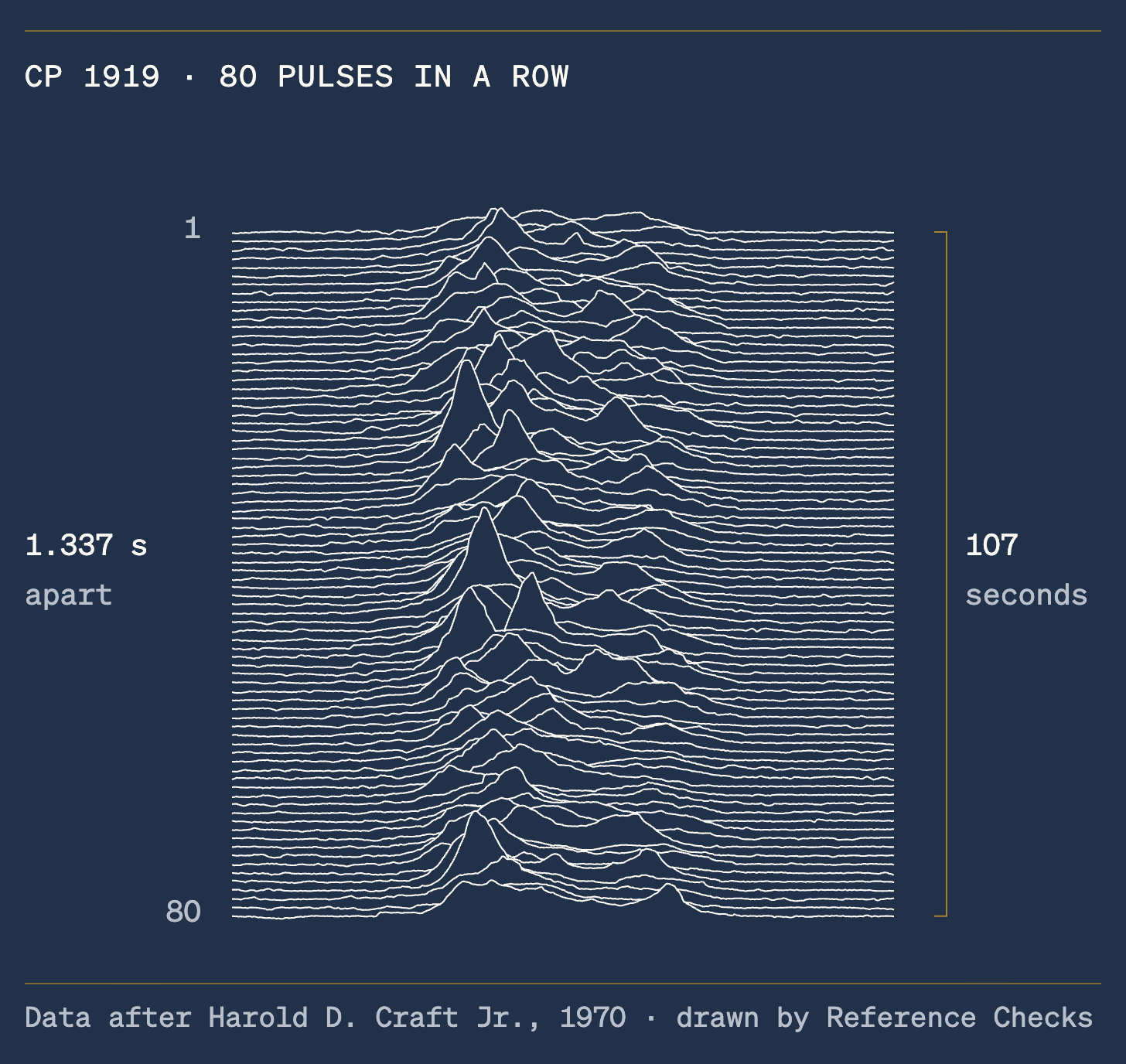
Harold D. Craft Jr. plotted those pulses as a Cornell graduate student for his 1970 thesis, and the band found the chart in The Cambridge Encyclopaedia of Astronomy. Craft found out when a colleague ran into him on the street and asked if he knew it was on a Joy Division record. He went out and bought one, poster and all.
Hook remembers the first pressing as 10,000 copies, and renting a van with the band's manager, Rob Gretton, to drive down to London and pick them up. All 10,000 came in that cover, and so does the LP you can order new today, with a shrink-wrap sticker that spells it out in 9 words: "Replicating original album artwork, cut from the 2007 remasters." So what you'd bring home is the 1979 cover with a cut that came out in 2015.
Factory put the album out under one catalog number, and the record under that number has been cut at least 8 times. The dead wax will tell you which one you're holding.
The short answer
This one gets a single vinyl pick that came off 3 pressing plants, 2 CDs that tie, and a download for convenience.
Best overall on vinyl is the first UK cut, George Peckham's, and he signed it: A PORKY PRIME CUT, right there in the dead wax. WEA pressed the first copies at West Drayton in 1979, the ones in the textured cover. Tranco pressed it that same year, and Lyntone again in 1981 off the same metal, adding its own numbers. Any of the 3 will do, and since none of them is sold new, you're buying used. On Discogs, users hold 15,118 copies across the 4 entries for those pressings, and the sale medians run from $83 for the Lyntone to $253 (November 10, 2026).
Best overall on CD is a tie between the first CD, Factory's 1986 disc pressed in France, and the 2000 Australian London CD. They measure the same on the DR Database, and both are out of print. The European London CDs carry the same master, just 0.2 dB lower. Sale medians on Discogs run $20.11 for the 1986 disc, $8 for the Australian CD, and $6.70 for the European London CD (November 10, 2026).
The Reference Buy List has the pick for every record I've researched.
That is the pick. A free subscription opens everything behind it: the best copy by format, the near-peers and the cautions, the catches, the chain from the session tape to your copy, and the people in the room when it was made.
Reference Checks is a Twelve Bar Studio production. If you've ever bought a record everyone praised and wondered why yours didn't sound like the one they meant, that's the problem I started it to solve. If there's a record you've never been sure which copy to buy, reply and name it. Every title gets logged and the list helps decide what gets researched next. My listening chain is calibration context, named in the About page and kept out of every verdict. Research uses AI tooling; the verification and the editorial are mine. See Editorial process.