



Edition №19
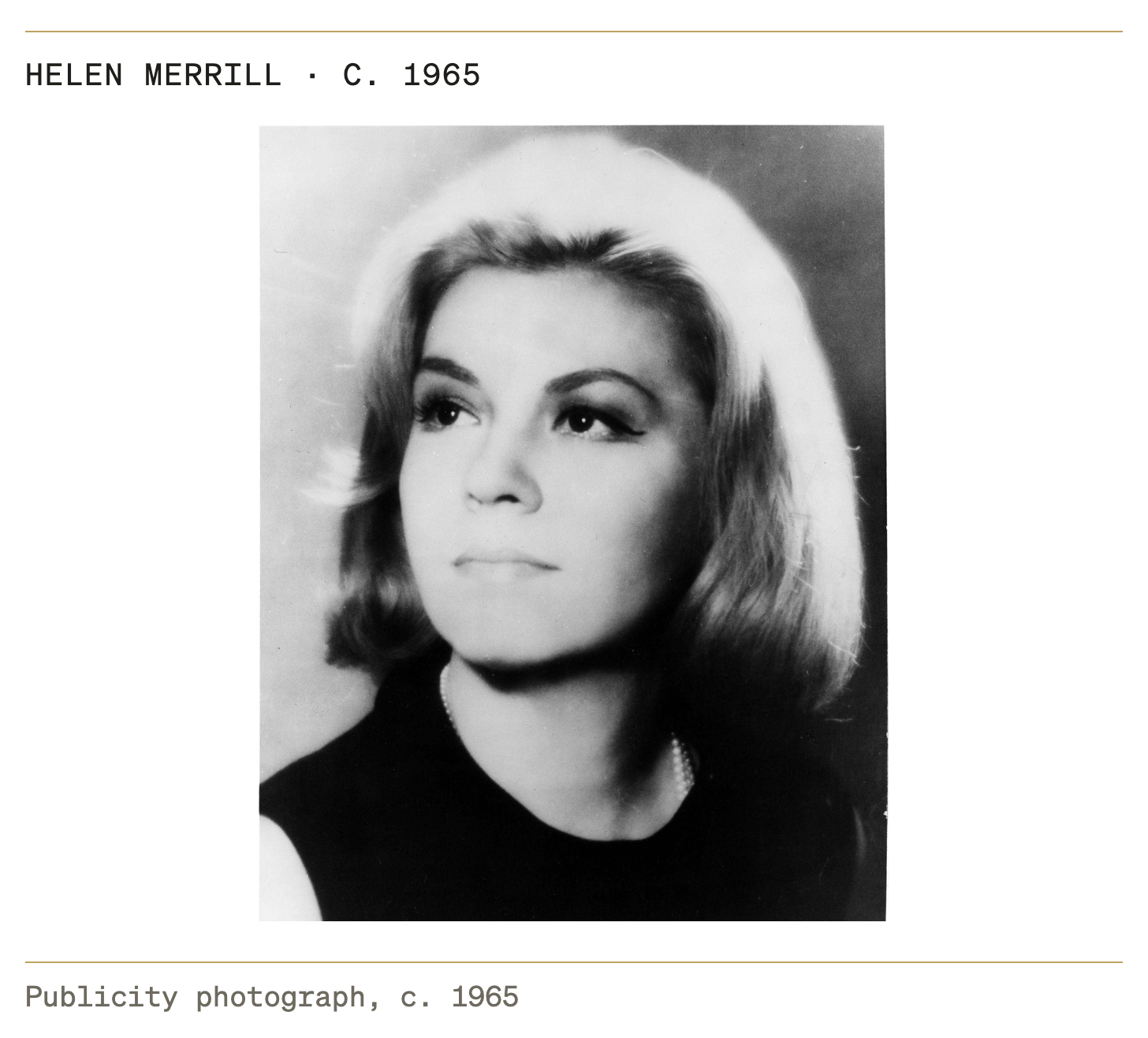
Helen Merrill made her first album in New York in December 1954, with Clifford Brown on trumpet and Quincy Jones writing the arrangements, and by her own account both singer and trumpeter were a little frightened. “Gosh, I was so shy on that date,” she told Marc Myers of JazzWax in 2009. “I thought I was going to have a heart attack. So did Clifford.” Brown was 24 and, in her words, “known among musicians but not famous yet,” and Jones, at 21, was living in a brownstone basement with no money, the way she remembered it.
She and Brown barely talked. In her memory he was “miles away from me,” and the photographs she saw later showed a room smaller than she remembered. A retake was never her idea, because she thought she had to get it right the first time. “We just smiled at each other a lot,” she said, and she believed “you can still hear that unspoken conversation on there today.”
“It continues to be a huge hit in Japan,” she said in the same interview, and whenever her band started the intro to “You’d Be So Nice to Come Home To,” “audiences go nuts. They know what’s coming.” The song had become hers there. “That song is my ‘I Left My Heart in San Francisco,’” she said. The album carries a Japanese catchphrase too, “New York’s sigh,” and neither Japanese source I read says who coined it.
The singer behind “New York’s sigh” moved to Tokyo in 1966, and by her account living there cost her some of that following. Audiences “didn’t know what to make of me,” she said, and she thought they would have been more excited “if I was living in the U.S. and touring in Japan.” In 2009 she still loved the country deeply, she said, and she had missed New York terribly while she was there: “I always felt like a stranger.”
Of the 62 versions of the album on Discogs, 37 are Japanese and 13 are American. The copy you want is American: Kevin Gray’s 2020 cut from the original master tape, and it is still sold new.
The short answer
This one gets one vinyl pick that is still sold new, two CDs made from two different transfers of the tape, and one download.
Best overall on vinyl is Analogue Productions’ reissue, cut in mono by Kevin Gray at Cohearent Audio from the original master tape and pressed at QRP. It came out in 2020 on 200 grams and sells today on 180, and Acoustic Sounds told me on November 10 that the 180-gram pressing uses Gray’s 2020 cut and only the weight changed. Buy it at either weight. It sells new for $39.99 at Elusive Disc and $40 at Acoustic Sounds (November 11, 2026).
The Reference Buy List has the pick for every record I've researched.
That is the pick. A free subscription opens everything behind it: the best copy by format, the near-peers and the cautions, the catches, the chain from the session tape to your copy, and the people in the room when it was made.
Reference Checks is a Twelve Bar Studio production. If you've ever bought a record everyone praised and wondered why yours didn't sound like the one they meant, that's the problem I started it to solve. If there's a record you've never been sure which copy to buy, reply and name it. Every title gets logged and the list helps decide what gets researched next. My listening chain is calibration context, named in the About page and kept out of every verdict. Research uses AI tooling; the verification and the editorial are mine. See Editorial process.