

Boxer: The Conservation Copy
Edition №1, continued. A free preview of the Reference Checks paid tier.


Edition №1 named the verdict on Boxer. This is the other half of that work, and a preview of what the Reference Checks paid tier will read like when it opens to subscribers.
Every paid edition will carry two pieces: an editorial reading like this one, the argument and consequence behind the verdict, and the full chain-of-custody dossier, every pressing, matrix, plant and identifier the research touched. The reading below is free in full, and a short sample of the dossier sits at the foot, so you can see the second half too. The dossier joins the reading in full when the tier opens.
If you want to know when that happens, the free subscription is how you’ll hear about it.
The verdict is free. Subscribe and read the rest.
The Conservation Copy
Boxer · The National · Beggars Banquet · 2007
Reference Checks · paid reading
A 2007 mastering decision split Boxer into two records. Only one of them still carries the dynamics the sessions captured.
I. 2007
In December 2007, seven months after Boxer reached stores, Rolling Stone published a piece called “The Death of High Fidelity.” It was about a mastering practice that had quietly become the house style of the record business: the steady push to make every release louder than the last. Engineers had a name for it. The loudness war.
The practice was not new in 2007. It had been building for more than a decade, since digital mastering made it easy to raise a record’s level without obvious penalty. The logic was competitive. A louder track jumped out of a radio segue or a shuffle, and once one label pushed its levels up, the next had to match it or sound timid. Loudness climbed a decibel at a time, and by the middle of the 2000s mastering engineers were compressing records they knew they were hurting.
The method was simple and the cost was not. A CD has a hard digital ceiling above which sound breaks up. No track can go past it, so engineers compressed the dynamic range instead, lifting the quiet passages toward the loud ones and pressing the whole signal against the limit. The record got louder. The detail that lived between soft and loud got squeezed out.
The disc itself was never the limit. A CD can hold far more dynamic range than any LP, and the loudness war spent that capacity on volume instead. The practice was a choice, made one master at a time.
“The idea was to slam someone’s face against the wall. You can set your CD to stun.” — Rob Cavallo, producer, Rolling Stone, December 2007
Boxer’s CD shows the practice at work. Dynamic range is measured on a simple scale, a higher number meaning more distance between the softest and loudest moments, and the disc reads DR5. Across the band’s catalog the CDs run DR5 to DR9; Boxer sits on the floor. The peaks ride a tenth of a decibel below the ceiling across most of the album. On a record this restrained, that is a hard figure to look at.
There is a perceptual trick underneath the practice. Played back to back, the louder of two masters sounds better on first listen, fuller and more present. The advantage does not survive a full sitting. A record with no dynamic relief wears the listener down; engineers call it ear fatigue. The loud master wins the audition and loses the evening.
2007 was one of the loudest years the industry ever ran, though not the worst of it. The most notorious case arrived the next year. Metallica’s Death Magnetic came out in 2008 measuring DR3, and fans noticed the version inside the Guitar Hero video game sounded better than the CD. The tracks had gone to the game before the loudness mastering was applied. People traded rips of the game audio in place of the disc, a petition demanded a remaster, and the album’s mastering engineer, Ted Jensen, said the mixes were already brickwalled when they reached him. Boxer was made by people working to the standard of the moment.
The technical turn in the story is small and decisive. Fred Kevorkian mastered Boxer at his studio in New York, and that single master became the source for every official edition: CD, digital download and vinyl. A master is only the starting point. Each format decides what finally reaches the listener, and here the paths split. The loudness decision for Boxer’s digital editions was made once, in 2007, and never made again. What follows is the question of which copy came through whole.
II. The album that refuses
To see what the decision cost, you have to know what kind of record the band had made. Boxer is The National’s fourth album, and it runs on restraint. On Alligator, the 2005 record that built their reputation, Matt Berninger screamed; the biggest songs ended with him pushing what Stereogum called his “Jack ‘n’ Coke baritone” to the top of its range. For Boxer he refused to do it again. He told the band ahead of time that the screaming was out, and he held the line. Bryce Dessner remembers the rest of the band spending the entire two years the album took to make trying to talk him out of it.
“I wanted them to make a record that really got rid of guitars but made it possibly very aggressive, heavy music, but with orchestral instruments. They went the opposite way.” — Peter Katis, producer, AV Club oral history
Arrangement replaced volume. Padma Newsome, a composer who co-founded the group Clogs with Bryce Dessner at the Yale School of Music, wrote the chamber parts: dark winds, bassoon and bass clarinet and trombone, set against strings, at densities the band had not worked with before. For the end of “Fake Empire” he wrote the horn fanfare Bryce described as “very Steve Reichian,” a minimalist composer’s gesture inside a rock song. The result was quieter and more composed than anything The National had released, and it moved deliberately away from what the producer wanted.
The refusal reached the recordings themselves. The band tracked much of Boxer at Tarquin Studios and decided it sounded too clean. Ryan Pinkard, who wrote the 33⅓ book on the album, recounts the verdict: “We sounded like U2.” So they re-recorded much of it on rougher gear and scuffed the surfaces on purpose. A band reaching for a hit would have done the opposite. Berninger described the choice as painting themselves out of any corners and not worrying about chasing the light.
That choice carries a consequence most listeners feel before they can name it. A record built on restraint is a record built on dynamic range. Its meaning lives in the distance between the hushed passages and the few times the band lets the level climb. “Fake Empire” stays quiet for most of its length before the horns arrive. “Slow Show” holds back until its final minute. The design depends on the quiet staying quiet, because the loud moments only register if there is somewhere lower to rise from.
Reviewers heard it at the time. Stereogum noted that Berninger never raises his voice on the record and had never sounded so refined. The AV Club wrote that Boxer refuses to drop in the controlled-detonation rockers that defined the album before it. The restraint was the most visible thing about the record, an argument made in performance, before mastering touched a single track.
That is what the 2007 decision flattened. The CD master compressed Boxer to DR5, pulling the protected quiet up toward the loud. The contrast the band defended through the whole making of the record got narrowed at the last step, after every performance choice had been settled. The notes are all still there on the CD. What the compression removes is the dynamic distance between them, the exact quality that gave the record its character.
III. The conservation copy
The vinyl is where Boxer’s dynamics held on, and the reason is mechanical. Vinyl physically resists the loudness treatment a CD accepts. A lacquer is cut by a stylus carving the waveform into a moving groove, and a heavily compressed, squared-off signal is something that stylus cannot cleanly follow. Cut too hot and the groove distorts, the playback needle mistracks, the cutting head can overheat. Out-of-phase low end has to be summed toward the center or the stylus can jump the groove. Sibilance a CD shrugs off can outrun what a cartridge can trace. For all these reasons the level that governs a vinyl cut is the average, not the peak, the reverse of what loudness mastering does.
Cutting engineers sometimes go further and prepare a separate vinyl master that bypasses the brickwall limiter, because the format rewards the headroom a CD discards. Even the disc geometry resists loudness near the label, where the groove slows and high frequencies fade, so engineers cut quieter there and sequence the gentler songs last.
Engineers who cut records describe the upshot directly.
“With ‘hyper-compressed’ loudness-war music there’s ironically plenty of unused headroom left above the average signal on the vinyl for peaks and transients, which is why some people choose to make more dynamic masters for vinyl.” — Ian Shepherd, mastering engineer, Production Advice
No one at Beggars Banquet set out to make Boxer’s vinyl an archival document. The headroom is a byproduct of the format’s physics. The loudness treatment lives in the digital editions, and a lacquer could not run it. What came off the cutting lathe behaves like a different record, cut with the room the groove demanded and described across fourteen years of listener reports as the open, dynamic version of the album.
To be precise about the claim: Boxer’s vinyl is the same Kevorkian master as the CD, taken down a different path. The entire difference between the editions happens in the handling after that master. Same source, treated two ways.
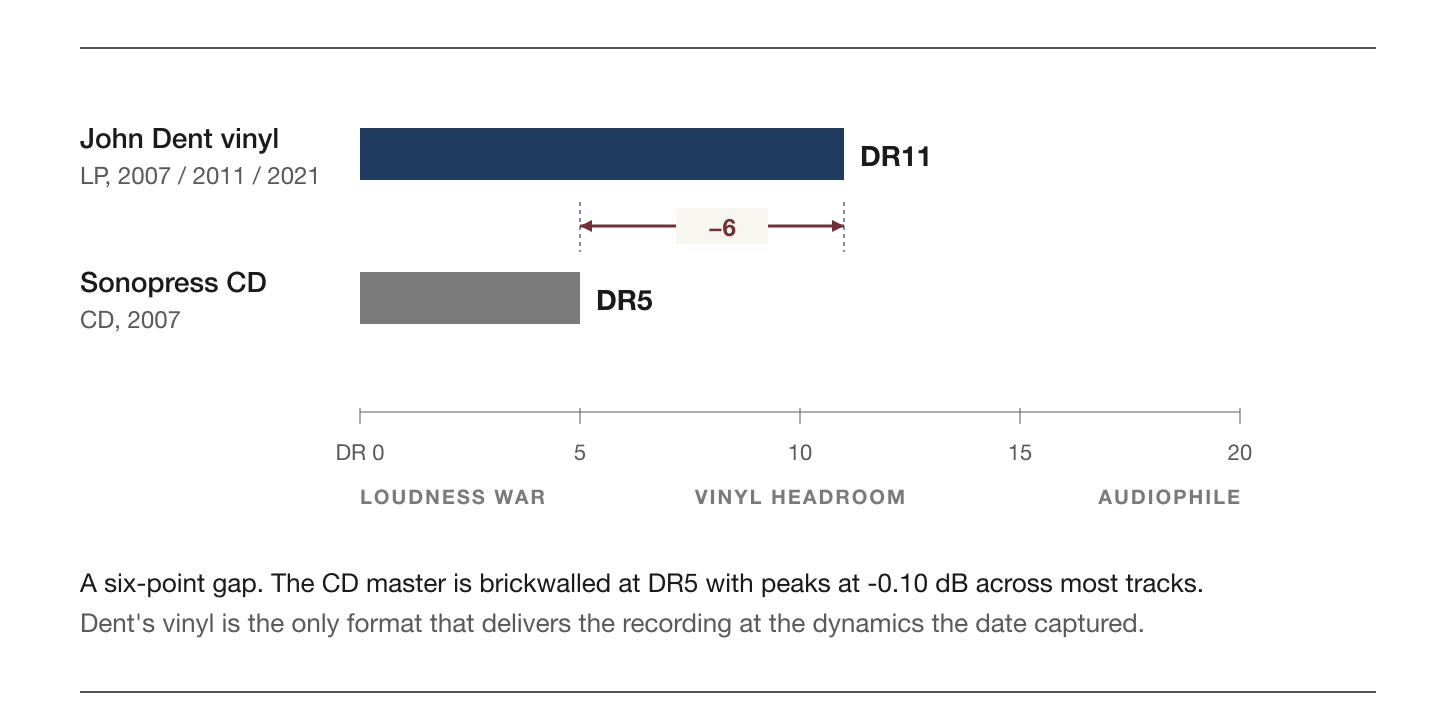
The measurements track the difference, with one caveat stated plainly. The vinyl reads DR11 against the CD’s DR5, a six-point gap, though that figure is inferred, measured on the US pressing and carried to the reference cut, and dynamic-range meters cannot cleanly compare a vinyl rip to a digital file. The exact size of the gap is less certain than its direction. The mechanism is not in question. The CD was compressed to the era’s standard, and the groove would not take that treatment.
The pattern holds across the catalog: Alligator at DR10 against the CD’s DR6, Sleep Well Beast at DR10 against a DR5 digital master. Boxer’s gap is the widest, which fits a very quiet record run through a very loud master.
The reference vinyl is John Dent’s cut, made for the UK and European pressing and reused on the reissues since. It is the copy that holds the dynamics. The US cut came noisy, a separate matter the free edition takes up.
On a resolving system the difference is easy to hear. The Dent vinyl lets “Fake Empire” build from near silence, the horns arriving with room above them. The CD opens most of the way up the wall and stays there, so the same arrival has less distance to travel. The performances are identical. The space around them is what the loudness decision spent.
What gives the conservation copy its weight is how settled that decision turned out to be. The CD and digital editions still carry the original Kevorkian master, untouched. In 2021 the band remastered three early titles, the debut, Sad Songs for Dirty Lovers and the Cherry Tree EP. Boxer was left alone. The band knows how to revisit a master when it wants to, and it has not done so here. The 2011 and 2021 vinyl reissues press from Dent’s original 2007 cut, the runout matrices identical down to the stamp. The loud digital master has been the only one in circulation since the day it was made. A listener who wants Boxer at the dynamics the sessions gave it has one place to go, and it is the format the industry had filed under nostalgia. The year before Boxer arrived, vinyl sales in the United States bottomed out under a million LPs.
None of this belongs only to Boxer. Records made through the loudness-war years often exist in two materially different versions, a compressed digital master and a vinyl cut the format forced to stay more dynamic. For many of those titles the vinyl is the conservation copy, an outcome the physics of the groove produces on its own. Boxer is a clean case because the record it preserves is so quiet and the master it corrects is so loud.
The argument indicts a practice, not a format. Where the digital master kept its dynamics, the CD can be the best copy, and other Pressing Council analytics have put CDs first on other titles. This edition makes the point itself: the copy to avoid is a vinyl edition, one of the top picks is a CD. The conservation copy is found record by record.
The pattern still leaves the listener a practical test: when a record from these years sounds flat or tiring on disc or stream, check the vinyl, because the loudness lives in the master and the cut often escapes it.
Most listeners meet Boxer through the digital editions. The vinyl is the copy that kept what the sessions put down, the same mastering chain spared the loudness treatment by the limits of the groove. Nineteen years on, it is still the only edition that carries the record at the dynamics it was given. The conservation copy was sitting in the format the industry had written off.
The dossier sample
This is the chain-of-custody record behind the verdict: the identifiers that let you confirm a copy before you buy it. Here is one entry from the Boxer dossier, the Best Overall chain.
Master ID. Discogs Master 15110 · MusicBrainz Release Group 9facb475-4c5f-369b-9b93-1280e6669090
Best Overall — the John Dent vinyl, Optimal Media pressing
Spec. BBQLP 252 · matrix B782899-01 (sides A1 / B1), JONZ LOUD signature · Fred Kevorkian master, lacquer cut by John Dent at Loud Mastering · pressed at Optimal Media Production, Germany (plant code B782899)
Years. 2007 UK & Europe (Discogs 10674289) · 2011 Worldwide Yellow reissue (Discogs 3120491) · 2021 UK Limited Gold, 500 copies (Discogs 19608397)
Why it holds. One set of lacquers across 14 years. The same matrix B782899-01 and Dent’s JONZ LOUD signature carry through all three pressings, so a copy from any of the three years traces to the same cut. Dent died in 2017, and the 2021 reissue presses from his original 2007 lacquers.
That is just one custody chain. The full dossier carries the rest: the three CD families with their Sonopress plant codes, the lossless download surfaces, the near-peer US cut and the edge-case regional pressings. It joins the in-depth reading above when the paid tier opens.